
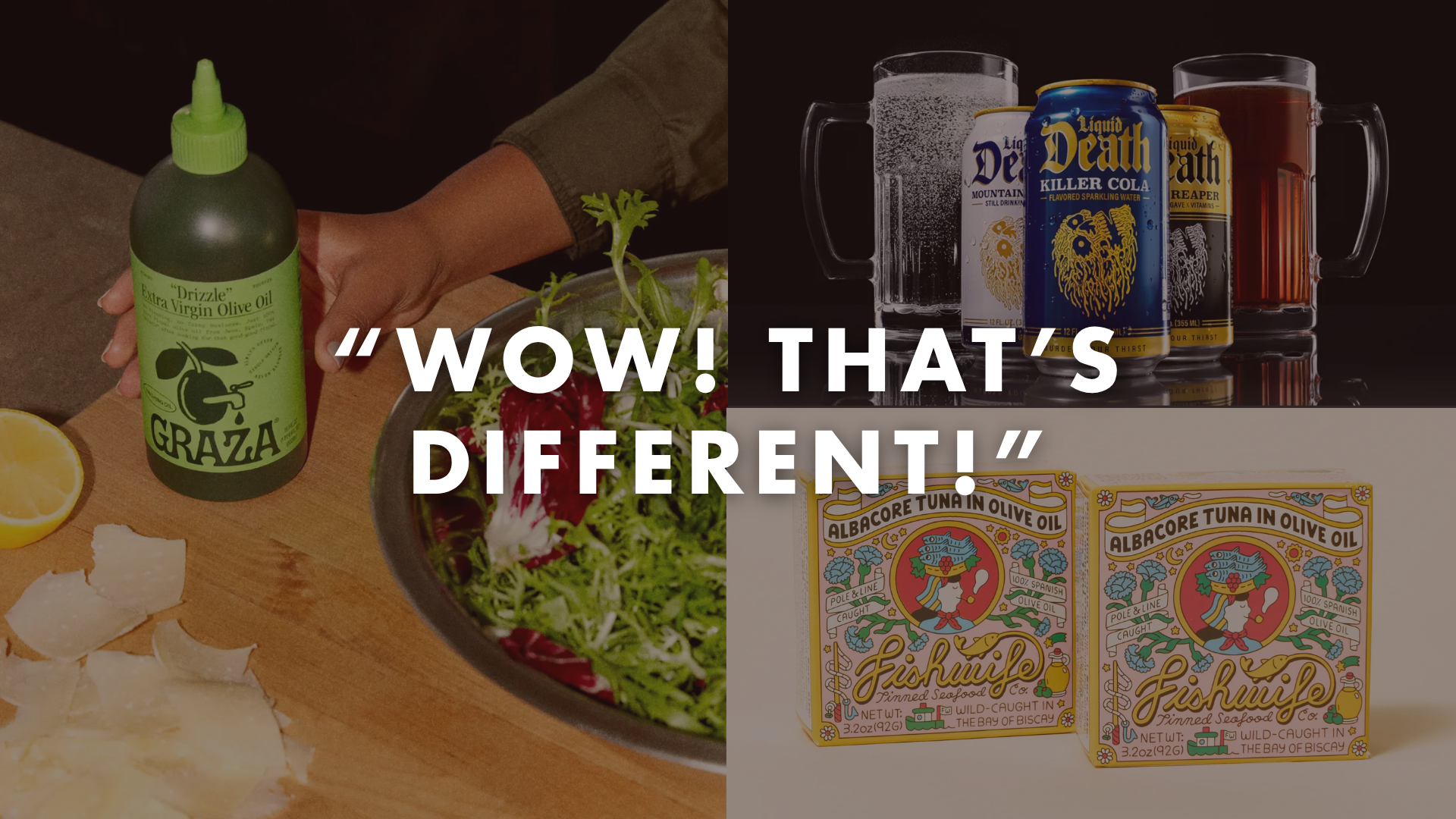
Graza olive oil. Fishwife tinned fish. Liquid Death canned water. Direct-to-consumer brands are re-imagining what they can accomplish in their saturated, legacy-brand-rich markets. This trend aims to position brands in front of a slightly different audience than their competitors — a customer who is willing to branch out, try something new, pay a premium for perceived quality, and "join a movement" toward x, y, or z. The current customerscape has permitted these brands to try a new philosophy. Here at Novella, we're giving B2B brands permission to do the same thing.
A strategy like this first requires a deep dive into your customer base — thinking beyond demographics, purchasing behaviors, and preferences. We're asking:
- Does our customer care about functionality only, or do they prefer a brand with a little bit of "sauce"?
- In a customer's most selfish state, what do they look for in a product that makes them feel better about their image or social status?
- Where do our customers spend their "fun money"? Is it shopping at the mall? Golfing? Massages or the nail salon? The most expensive gym membership in town? Subscription services? Books and movies? Energy drinks and sodas from the gas station?
Some of these questions may feel silly for a B2B brand, but they're crucial to getting to a customer's "why." Once you've identified the nitty-gritty details of why a prospect might invest in your brand's ethos over another's, then it's time to get creative about how to speak their language.
This tactic may not work for every brand, BTW.
If your brand is a 70-year legacy wealth management company targeting older Gen-Xers and Boomers who value a "no frills" experience, then a provocative visual brand and language guide may not be your friend. But this type of brand still requires a strategy of its own — one that ensures the customer doesn't mistrust the imagery or language coming from a company in which they invest a lot of their time, money, and trust.
On the flip side, some B2B brands may think, "that tactic won't work for us," when in reality, it absolutely could. Two brands in a category can serve relatively the same function, yet capture two different audiences. A recent example: ChatGPT vs. Claude. To put this to the test, we asked Google's AI Overview two simple questions:
Who is ChatGPT's target audience? Answer: everyday consumers, students, professionals, and enterprise businesses
Who is Claude's target audience? Answer: professionals, software developers, researchers, small business owners, and enterprises who use AI as a deep-thinking partner for complex tasks like coding, data analysis, and structured writing, rather than casual entertainment
What can we learn from this? ChatGPT targets everyday people, while Claude targets creatives, deep thinkers, and professionals who care about brand — and who won't mind a bit of provocation. When you compare the advertising of these two companies side by side, you see the difference.
How can my brand disrupt our market?
Great question — thanks for asking! Once you've done a deep dive into your audience's psychographics and core motivators, it's time to reflect on your brand's voice and tone. Do we want to be funny and witty? Serious and sleek? Intelligently provocative? Obscure and obtuse? Friendly and approachable, like your parents' next-door neighbor, Hank? From there, it's about building a brand messaging strategy that tells your brand's story so that everyone — your internal team, your external partners, and even the customers telling your story on your behalf — is working from the same script.
Having the foundation of a brand strategy is crucial before taking a major step toward visual changes. The visuals and the words should feel like they're cut from the same cloth. Once you're ready for visuals, it's important to work with a designer or team of designers who will use your brand strategy as a jumping-off point. And when they hand your new brand over to your team, they should set you up with brand parameters so your internal team can effectively carry out the vision.
A disruptive brand doesn't have to be provocative — it just needs to make customers and competitors stop in their tracks and think, "wow, that's different!"
For example, the Novella team worked with B2B brand HIX, a manufacturing company that designs and builds commercial textile printing equipment, food service machinery, and industrial ovens. Our challenge was to create a brand system that worked for HIX Corp. as a parent brand, with their additional product lines as unique sub-brands underneath. The goal was to modernize their look while staying true to the company's heritage.
Our creative strategy was based on a modular system inspired by their products. Because we were working with multiple brands, we knew the logo system needed to feel cohesive. Even though they're a B2B manufacturer, we crafted a well-designed, compelling story—visually and through messaging. See how it turned out here.
Before and After
Subbrand System
Where do I begin?
If it feels like the right time for a brand refresh — not just visually, but tonally, and potentially with a brand repositioning in mind — we can help you start. How do you know it's the right time? Well, when you start to feel like "we've been doing the same thing for a while now, talking to the same customers, but it feels like we're not moving the needle forward." That's a sign. Another common one we hear: "our market is growing more competitive, and all of us sound the same." We get you!
When you're ready to talk this through, we're here to dive in.
